Pass-Sure FCSS_LED_AR-7.6 Free Download by Actual4Labs
Wiki Article
What's more, part of that Actual4Labs FCSS_LED_AR-7.6 dumps now are free: https://drive.google.com/open?id=1YAWbAS0dKqQmu-vBct1ZGFiaKidQK4i6
One of the most effective ways to prepare for the FCSS - LAN Edge 7.6 Architect FCSS_LED_AR-7.6 exam is to take the latest Fortinet FCSS_LED_AR-7.6 exam questions from Actual4Labs. Many candidates get nervous because they don’t know what will happen in the final FCSS - LAN Edge 7.6 Architect FCSS_LED_AR-7.6 exam. Taking FCSS_LED_AR-7.6 exam dumps from Actual4Labs helps eliminate exam anxiety. Actual4Labs has designed this set of real Fortinet FCSS_LED_AR-7.6 PDF Questions in accordance with the FCSS_LED_AR-7.6 exam syllabus and pattern. You can gain essential knowledge and clear all concepts related to the final exam by using these FCSS_LED_AR-7.6 practice test questions.
Fortinet FCSS_LED_AR-7.6 Exam Syllabus Topics:
| Topic | Details |
|---|---|
| Topic 1 |
|
| Topic 2 |
|
| Topic 3 |
|
| Topic 4 |
|
>> FCSS_LED_AR-7.6 Free Download <<
Useful FCSS_LED_AR-7.6 Free Download to Obtain Fortinet Certification
Many clients worry that after they bought our FCSS_LED_AR-7.6 exam simulation they might find the exam questions are outdated and waste their time, money and energy. There are no needs to worry about that situation because our FCSS_LED_AR-7.6 study materials boost high-quality and it is proved by the high passing rate and hit rate. And we keep updating our FCSS_LED_AR-7.6 learing quiz all the time. We provide the best FCSS_LED_AR-7.6 practice guide and hope our sincere service will satisfy all the clients.
Fortinet FCSS - LAN Edge 7.6 Architect Sample Questions (Q39-Q44):
NEW QUESTION # 39
A FortiSwitch is not appearing in the FortiGate management interface after being connected via FortiLink. What could be a first troubleshooting step?
- A. Manually assign a static IP to the FortiSwitch.
- B. Verify that FortiGate device DHCP server is assigning an IP to the FortiSwitch.
- C. Ensure the FortiSwitch has internet access.
- D. Ensure that the FortiGate security policies allow traffic from the FortiSwitch.
Answer: B
Explanation:
When a FortiSwitch connects over FortiLink, one of the first things to verify is that it is receiving an IP address from the FortiGate DHCP service on the FortiLink interface. Without that address assignment, the switch cannot properly establish management communication and appear in the FortiGate interface.
NEW QUESTION # 40
Refer to the exhibit.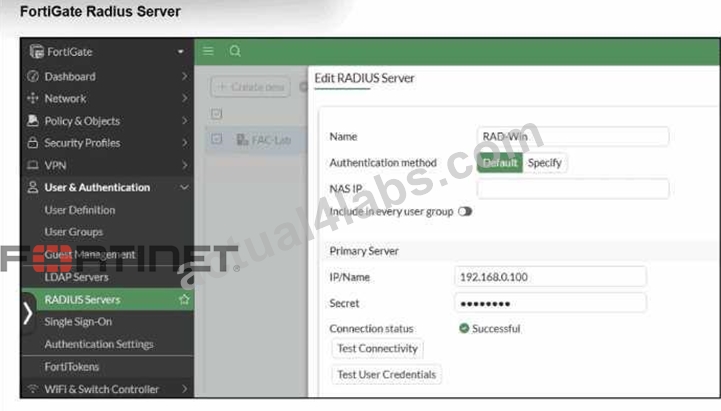

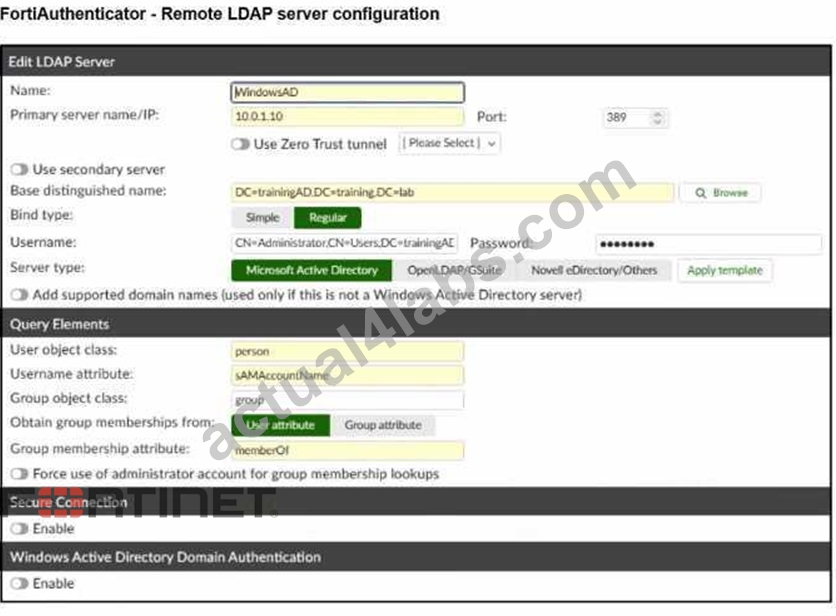
A RADIUS server has been successfully configured on FortiGate, which sends RADIUS authentication requests to FortiAuthenticator. FortiAuthenticator, in turn, relays the authentication using LDAP to a Windows Active Directory server.
It was reported that wireless users are unable to authenticate successfully.
The FortiGate configuration confirms that it can connect to the RADIUS server without issues.
While testing authentication on FortiGate using the command diagnose test authserver radius, it was observed that authentication succeeds with PAP but fails with MSCHAPv2.
Additionally, the Remote LDAP Server configuration on FortiAuthenticator was reviewed.
Which configuration change might resolve this issue?
- A. Enable Windows Active Directory Domain Authentication.
- B. Use RADIUS attributes under the FortiGate configuration.
- C. Change the RADIUS authentication protocol to CHAP
- D. Manually add user credentials to the FortiAuthenticator local database
Answer: A
Explanation:
From the exhibits and text:
FortiGate -> RADIUS -> FortiAuthenticator
FortiAuthenticator -> LDAP Windows -> AD
diagnose test authserver radius ... papsucceeds
diagnose test authserver radius ... mschap2fails
This behavior matches a classic limitation documented in FortiOS:
When usingLDAPas the back-end, the RADIUS server must usePAP. CHAP/MS-CHAPv2 arenot supportedwith plain LDAP because the server cannot validate the challenge Response without access to password hashes.
In the Remote LDAP server config on FortiAuthenticator, the option"Windows Active Directory Domain Authentication" is disabled.When this feature isenabled, FortiAuthenticator can talk to AD usingKerberos/NTLMinstead of a simple LDAP bind, whichdoes support MS-CHAPv2for incoming RADIUS authentications.
So to allow MS-CHAPv2 all the way from FortiGate to AD, you must:
Keep FortiGate using RADIUS with MS-CHAPv2 -> FortiAuthenticator
EnableWindows Active Directory Domain Authenticationso FortiAuthenticator can properly validate MS-CHAPv2 against AD.
NEW QUESTION # 41
How does the Syslog-based single sign-on (SSO) feature in FortiAuthenticator function to correlate user activity with authentication events across multiple network devices?
- A. It authenticates users through a captive portal by monitoring login attempts.
- B. It uses syslog messages to monitor authentication events and correlate them with user activities.
- C. It relies on external servers to analyze syslog messages for user authentication.
- D. It modifies user credentials based on the outcome of authentication events.
Answer: B
Explanation:
Syslog-based SSO in FortiAuthenticator works by listening to syslog messages from network devices (such as firewalls, VPNs, or wireless controllers). It parses authentication events from these logs and correlates them with user IPs or sessions, enabling user identity tracking and seamless single sign-on across the network.
NEW QUESTION # 42
Refer to the exhibit.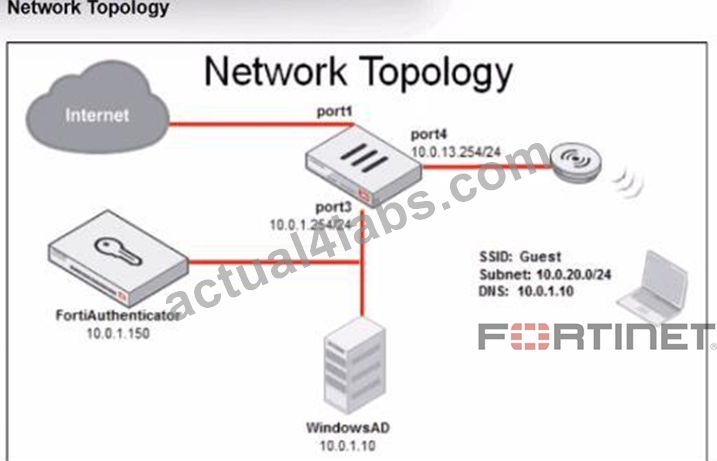
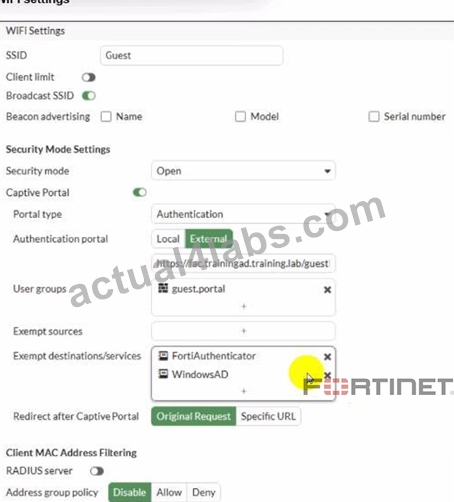
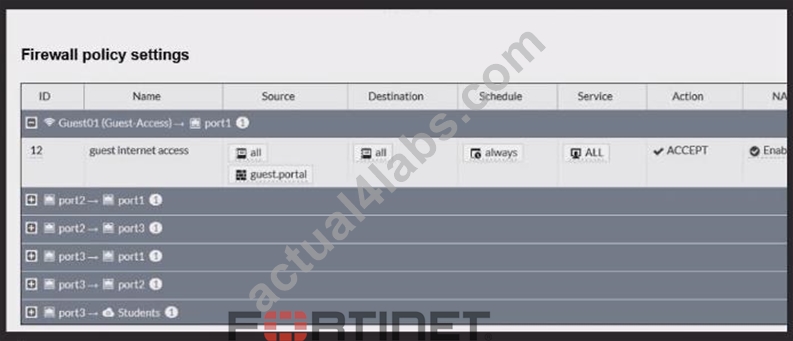
Review the exhibits to analyze the network topology, SSID settings, and firewall policies.
FortiGate is configured to use an external captive portal for authentication to grant access to a wireless network. During testing, it was found that users attempting to connect to the SSID cannot access the captive portal login page.
What configuration change should be made to resolve this issue to allow users to access the captive portal?
- A. Change the SSID security mode to WPA2-Enterprise for authentication.
- B. Exclude FortiAuthenticator and Windows AD address objects from filtering.
- C. Disable HTTPS redirection for the captive portal authentication page.
- D. A firewall policy allowing Guest SSID traffic to reach FortiAuthenticator and Windows AD.
Answer: D
Explanation:
From the exhibits:
* SSID "Guest"
* Security mode:Open
* Captive Portal: Enabled, portal typeAuthentication # External
* External portal URL: https://fac.trainingad.training.lab/guest (FortiAuthenticator)
* Exempt destinations/services:FortiAuthenticator and WindowsAD
* Firewall policy
* From theGuest interface/zonetoport1 (Internet)
* Source user group:guest.portal(authenticated users)
The flow for anexternal captive portalis:
* Client associates to theopen Guest SSID.
* Client makes an HTTP(S) request.
* FortiGate intercepts and redirects the client to theexternal portal.
* Client must be able toreach FortiAuthenticator's IP(and AD if the portal needs it)before authentication.
In this setup:
* Theexempt destinationsetting tells the captive portal logicnot to require authenticationfor traffic going to FortiAuthenticator and WindowsAD.
* However, there still must be a firewall policy that allows traffic from the Guest SSID subnet to those exempt destinations.
The existing firewall policy uses theguest.portal user groupas a source condition, which only matchesafter successful portal authentication. Before login, the client has no user identity, so:
* Traffic from the unauthenticated Guest client # FortiAuthenticator isnot matchedby that policy.
* It hits theimplicit deny, so the browser never reaches the login page.
To fix this, the administrator must:
* Create or modify a firewall policy thatallows traffic from the Guest SSID subnet/interface to FortiAuthenticator and WindowsAD without requiring user authentication.
That is exactly what optionDdescribes.
Why the others are wrong:
* A. Change SSID security mode to WPA2-Enterprise- External captive portals are normally used with openSSIDs; WPA2-Enterprise uses 802.1X, not captive portal.
* B. Disable HTTPS redirection- Redirection is required so users are sent to the portal; disabling it doesn't solve reachability.
* C. Exclude FortiAuthenticator and Windows AD from filtering- They're already listed asexempt destinationsin the SSID configuration; the missing piece is thefirewall policy, not the exemption.
NEW QUESTION # 43
Which encryption protocols can CAPWAP use to secure the data channel when communicating between a FortiGate wireless controller and FortiAP?
- A. SSH and SSL
- B. DTLS and IPsec
- C. WPA3 and TLS
- D. SSL/TLS and IPsec
Answer: B
Explanation:
The correct encryption protocols that CAPWAP can use to secure the data channel between a FortiGate wireless controller and FortiAP are DTLS and IPsec. DTLS (Datagram Transport Layer Security) is natively supported for CAPWAP encryption, and optionally, IPsec can be configured to further secure the tunnel, especially in high-security environments. WPA3 and TLS, SSH and SSL, or SSL/TLS and IPsec are not the protocols CAPWAP employs for this purpose on FortiGate and FortiAP platforms.
NEW QUESTION # 44
......
If you are curious or doubtful about the proficiency of our FCSS_LED_AR-7.6 preparation quiz, we can explain the painstakingly word we did behind the light. By abstracting most useful content into the FCSS_LED_AR-7.6 exam materials, they have helped former customers gain success easily and smoothly. The most important part is that all contents were being sifted with diligent attention. No errors or mistakes will be found within our FCSS_LED_AR-7.6 Study Guide.
Sure FCSS_LED_AR-7.6 Pass: https://www.actual4labs.com/Fortinet/FCSS_LED_AR-7.6-actual-exam-dumps.html
- Updated FCSS_LED_AR-7.6 Free Download - Perfect FCSS_LED_AR-7.6 Exam Tool Guarantee Purchasing Safety ???? Search on ▶ www.exam4labs.com ◀ for ⏩ FCSS_LED_AR-7.6 ⏪ to obtain exam materials for free download ????FCSS_LED_AR-7.6 Valid copyright Files
- Get Access To Fortinet FCSS_LED_AR-7.6 Questions Using Three Different Formats ???? The page for free download of 【 FCSS_LED_AR-7.6 】 on 《 www.pdfvce.com 》 will open immediately ????FCSS_LED_AR-7.6 Exam Review
- FCSS_LED_AR-7.6 Exam Review ???? FCSS_LED_AR-7.6 Exam Material ???? Test FCSS_LED_AR-7.6 Dump ???? Go to website ▷ www.practicevce.com ◁ open and search for ⇛ FCSS_LED_AR-7.6 ⇚ to download for free ????FCSS_LED_AR-7.6 Test Dumps
- FCSS_LED_AR-7.6 Exam Material ???? FCSS_LED_AR-7.6 New Test Materials ???? FCSS_LED_AR-7.6 Dump Collection ???? Search for ⏩ FCSS_LED_AR-7.6 ⏪ and download exam materials for free through ➤ www.pdfvce.com ⮘ ????FCSS_LED_AR-7.6 Valid copyright Files
- Accurate FCSS_LED_AR-7.6 Free Download - in www.prepawayexam.com ???? Search for 「 FCSS_LED_AR-7.6 」 and easily obtain a free download on ➡ www.prepawayexam.com ️⬅️ ↘FCSS_LED_AR-7.6 Reliable Dumps Pdf
- Intereactive FCSS_LED_AR-7.6 Testing Engine ???? Test FCSS_LED_AR-7.6 Dump ???? FCSS_LED_AR-7.6 Dump Collection ???? Search for ➽ FCSS_LED_AR-7.6 ???? and obtain a free download on ⇛ www.pdfvce.com ⇚ ????FCSS_LED_AR-7.6 Test Passing Score
- Test FCSS_LED_AR-7.6 Dump ✨ FCSS_LED_AR-7.6 Valid Test Guide ⛺ FCSS_LED_AR-7.6 Valid copyright Files ⏺ Search on ➽ www.practicevce.com ???? for ⇛ FCSS_LED_AR-7.6 ⇚ to obtain exam materials for free download ????FCSS_LED_AR-7.6 Test Dumps
- Valid FCSS_LED_AR-7.6 Exam Discount ???? FCSS_LED_AR-7.6 Valid copyright Files ???? FCSS_LED_AR-7.6 Test Dumps ???? Go to website ➡ www.pdfvce.com ️⬅️ open and search for { FCSS_LED_AR-7.6 } to download for free ????FCSS_LED_AR-7.6 Valid Test Discount
- Top FCSS_LED_AR-7.6 Free Download Free PDF | Professional Sure FCSS_LED_AR-7.6 Pass: FCSS - LAN Edge 7.6 Architect ???? Enter ➤ www.dumpsquestion.com ⮘ and search for ▷ FCSS_LED_AR-7.6 ◁ to download for free ????FCSS_LED_AR-7.6 Valid Dumps Free
- Useful FCSS_LED_AR-7.6 Dumps ???? FCSS_LED_AR-7.6 Unlimited Exam Practice ???? Useful FCSS_LED_AR-7.6 Dumps ???? Open ➤ www.pdfvce.com ⮘ enter ➡ FCSS_LED_AR-7.6 ️⬅️ and obtain a free download ????FCSS_LED_AR-7.6 Exam Review
- Efficient FCSS_LED_AR-7.6 Free Download | FCSS_LED_AR-7.6 100% Free Sure Pass ???? Open 【 www.prepawayexam.com 】 enter ⏩ FCSS_LED_AR-7.6 ⏪ and obtain a free download ????Test FCSS_LED_AR-7.6 Dump
- getsocialsource.com, www.stes.tyc.edu.tw, lewysczmy430570.evawiki.com, active-bookmarks.com, fatallisto.com, www.stes.tyc.edu.tw, karimzzxn965730.blogsvila.com, siambookmark.com, lilliysee685759.dailyblogzz.com, rishinqct499473.wannawiki.com, Disposable vapes
P.S. Free & New FCSS_LED_AR-7.6 dumps are available on Google Drive shared by Actual4Labs: https://drive.google.com/open?id=1YAWbAS0dKqQmu-vBct1ZGFiaKidQK4i6
Report this wiki page